
Hope Is Not Hype
Inside any situation, hope always exists. Here's how to find it.


Hope springs eternal. Or does it? I don’t want to give you false hope. Somewhere in between a wish and an aspiration, we find the construction of hope. Here’s how it works.
No matter what our circumstances, we always have a choice about how we react. Viktor Frankl says that we have the capacity to choose differently - as he discovered inside the most inhumane and cruel circumstances imaginable.
Frankl, a holocaust survivor who was imprisoned in the Nazi death camps in Germany, said,
“Everything can be taken from a person but one thing: the last of the human freedoms - to choose one’s attitude in any given set of circumstances, to choose one’s own way.”
In his book, Man’s Search for Meaning, Frankl goes on to say, “When we are no longer able to change a situation, we are challenged to change ourselves.”
The business case for hope is a simple one. Consider, right now, how many possibilities exist. For example, I could write (almost) anything. Travis Kelce. Avocados. Street signs. Some words are more uplifting, some have negative repercussions, and some things are better left unsaid.
But the point is: possibilities always exist.
How many possibilities would you say there are, right now, in this moment? I can keep writing. Stop writing. Make a sandwich. Book a flight to Peru. Whatever.
Just as music continues to be written to express its infinite possibilities, so too we can use a combination of words to generate ideas – an infinite number of ideas. From the past to the present, and even unique imaginings of the future, our minds are capable of so much more than we realize. Especially since the possibilities are infinite, in this moment - and every moment.
Because we don’t realize possibilities, we don’t recognize hope.
Hope always exists. Like gravity. You don’t have to believe in it, and it’s still there.
When people say, “All hope is lost!” it just means that they have lost the ability to find it.
Some view hope as fake optimism – a lie of the mind that delays the inevitable onslaught of disappointment and discouragement.
“I don't like hope very much. In fact, I hate it. It's the crystal meth of emotions. It hooks you fast and kills you hard. It's bad news. The worst. It's sharp sticks and cherry bombs. When hope shows up, it's only a matter of time until someone gets hurt.”― Jennifer Donnelly, Revolution
False hope is, perhaps, the crystal meth of emotions. Note that Donnelly was writing in a young adult novel, about a teen musician who just lost her brother. Indeed, grief and loss create a place where hope seems scarce. Replaced by sadness, there is no hope that the person who is lost will return. The loss of death is permanent. Does hope die as well? Depends on what you hope for.
The grief will linger, never to be replaced by hope that the person will somehow return. That would be a false hope.
Yet we can come to terms with that grief.
If you are struggling with loss right now, if you are facing a grief that blocks out any hint of hope, I want you to know: I’ve been there. I know what that’s like. And like you I don’t like it.
But from grief, I found hope. Not a false hope, not a delusion, not a lie of the mind. Hope that comes from acceptance and understanding is a hope that is real, present and waiting for all of us. Example: The hope that I would find a way to make my father’s memory a blessing. A way to find a new beginning in a final goodbye.
Hope for better days isn’t hype. It’s the acknowledgement of new possibility.
My grief never disappears. But neither does hope. I continue to hope that I will be the man that my father would have wanted me to be. But then, when I think about it, I know that I already am. There wasn’t anything left unsaid between us, even though he was taken from this world far too soon.
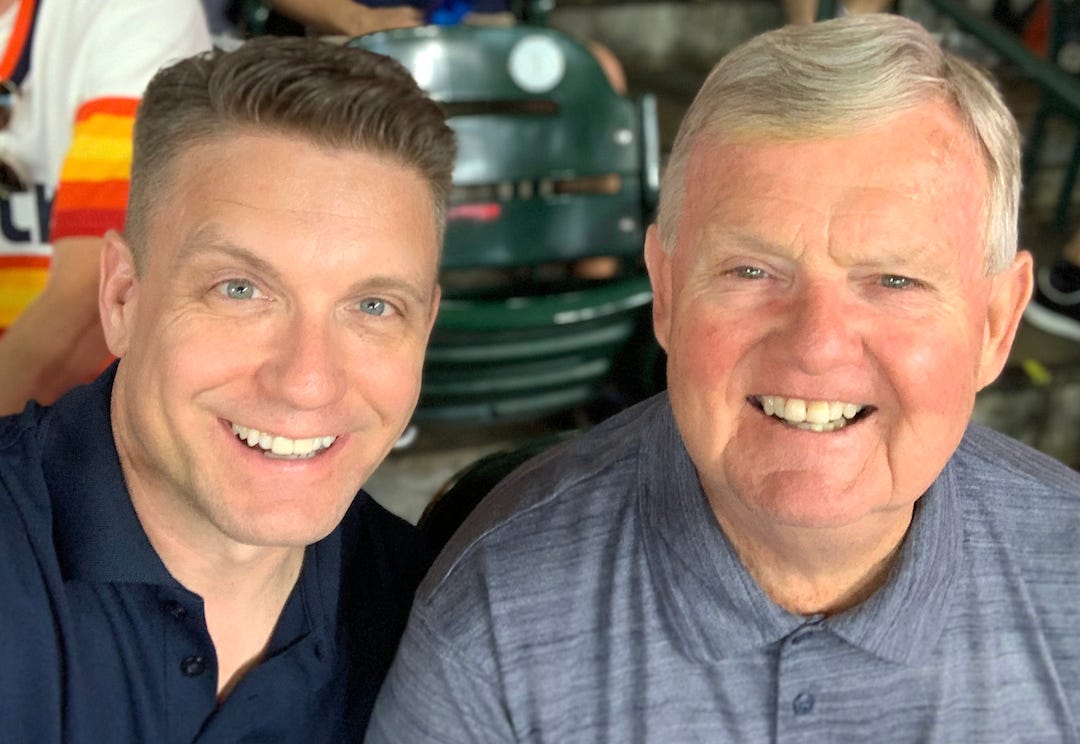
Hope is not something that shows up just before someone gets hurt. Hope shows up after you’ve been hurt. Maybe even because of it. That’s called resilience. And the fact that resilience exists is something that gives me hope.
Walt Whitman said, “I am large. I contain multitudes.”
He wasn’t just writing about how he felt after a satisfying Thanksgiving meal. He was talking about the possibilities that exist inside all of us. Inside these multitudes, grief exists. So does love, jealousy, anger and joy. That’s called “the human condition” – and learning to embrace all of it is part of the journey. Finding a way to be kind to yourself, when it seems that the universe has been cruel, is the first step towards hope.
When things are taken away, we discover grief. Frustration. Anger. Believe me, I’ve been there. Maybe you are there now. I had to find a way to turn away from “How am I going to get through this?” to a new point of view.
Somehow, I was able to ask, “What can I get from this?” My father died swiftly and tragically during the pandemic. From five states away, I could do nothing to stop the inevitable.
The only thing left was grief.
What can I get from this?
Perhaps an opportunity to share my journey with you. Perhaps a chance to remember, once again, what my dad meant to me. A memory of the good times, and the bad, to help me to step forward, once again, to honor my father and my friend.
If you’ve been through a difficult time, I hope you will continue to join me here on Finding Easier. We can find new pathways together.
Hope is here. Always. If that wasn’t the case, therapy, coaching and education would not work. Hostage releases would not happen, progress would not be made. Depression can come to anyone, anytime. But the good news is: hope is always just one thought away. And the power to change is one that we all possess. Doesn’t that thought give you hope?
I too, lost my father during the pandemic. He loved and lived his 78 years on his own terms. He told me to "hope in one hand and poop in the other, and see which one fills up first". Action with intention is how to live your best life. Physically, mentally and spiritually. I'll bet your dad is still beaming with pride from above, Chris.